
Onslow County Projected Release Dates
North Carolina uses the term projected release date, or PRD. NCDAC policy also uses “max out” for expiration of a sentence that has been fully served with no parole or post-release reporting requirement. A projection is an administrative calculation. It draws on the judgment, sentence structure, confinement credit, earned or good time, and later sentence events. A custody-review date is not a release date, and a PRD is not a promise that the person will leave custody that day.
Actual release is the completed custody event. For a state prisoner, use the release history and NCDAC's dedicated Inmate Release Search after the event. For an Onslow County jail sentence, ask Booking or request the maintained release record. A current roster can show who remains in the jail, but a missing name does not reveal whether the person entered the community, transferred to NCDAC, returned to another county, or moved to federal or immigration custody.
- Projected release date
- The agency's current sentence-based estimate, subject to lawful changes.
- Max out
- Sentence expiration with no parole or post-release reporting requirement under the cited NCDAC policy.
- Confinement credit
- Qualifying time already spent in custody that is credited toward the sentence.
- Detainer
- A notice or request tied to another authority that may affect where the person goes next.
Search Onslow County Release Dates
The best route depends on the custody system. NCDAC's OPI contains current and historical state prison, probation, and parole information back to 1972. It has no county-jail-only records. For someone believed to be in state custody, search the official record and open the detailed history. If a person already left state prison, the dedicated release search is more useful than relying on an old projection.
- Identify the custodian from the court record, Onslow County Sheriff information, or the most recent verified agency record.
- For state custody, open NCDAC OPI, choose All or Active Inmate as appropriate, and search by name plus offender number or date-of-birth details.
- Match the offender number and sentence history. Look for projected release information in the detailed record rather than treating a result-list label as the date.
- If release already occurred, use the NCDAC Inmate Release Search by county, month and year, or surname, then compare its release history.
- For an Onslow County jail sentence, read the judgment and call Booking at 910-937-1470 for the official local calculation and any known transfer or hold.
- If a public state field is missing, use NCDAC Public Records and request the existing public admission or release information with the offender number.
A no-result in the county-and-month search is not final. The release county can differ from the arrest county, county of conviction, or prison location. Repeat the search by surname and inspect full OPI history. “Inactive” is a lifecycle status for a person no longer active as an inmate or supervisee. It is not a substitute for the date and event in the detailed record.
Note: NCDAC cannot supply an Onslow county-jail booking or local release date because it expressly does not hold those records.
Onslow County Jail Release Date Limits
A pretrial detainee does not have a sentence-based projected release date. Bond, a recognizance decision, dismissal, trial, another court order, and outside holds can control whether and when release occurs. The eCourts judgment or order can explain the legal authority, but it does not show the moment Onslow County Detention Center completed processing. It also does not rule out transfer to another custodian.
For a sentenced county misdemeanant, start with the judgment and qualifying confinement credit. State law permits earned credit within the applicable rules, including a combined misdemeanant cap of four days per month under G.S. 15A-1340.20(d). Only the jail custodian can confirm the actual calculation, discipline effects, and other holds. No sound public calculator can turn those inputs into a guaranteed local release date.
| Custody situation | Best date source | Main limit |
|---|---|---|
| Onslow pretrial custody | Court orders plus Sheriff confirmation | No sentence-based date; bond and holds can change the result |
| Onslow sentenced jail term | Judgment plus jail calculation | The jail applies credit and checks other authority |
| NCDAC state prison term | OPI projection and release history | The projection changes with authorized sentence inputs |
| Federal sentence | BOP record | County and NCDAC systems do not establish federal release |
Calling the right office prevents a common error. Onslow County Booking handles local detention questions. NCDAC Combined Records authorizes state releases. BOP handles federal sentenced custody. A release from one of these systems does not prove that all other custody ended.
North Carolina Release Date Rules
For offenses on or after October 1, 1994, Structured Sentencing generally replaced discretionary parole. G.S. 15A-1340.13(d) requires service of the entire imposed minimum term. Earned time may reduce the maximum term, but never below that minimum. NCDAC describes the framework as serving 100 percent of the minimum and 85 percent of the maximum, followed by mandatory post-release supervision for covered felonies.
That explanation is more precise than a broad “85% rule.” It is not the federal earned-time system and does not mean every North Carolina offender serves a flat share of a sentence. The sentence date, offense class, judgment, minimum and maximum, and earned-time rules all matter. Older Fair Sentencing cases can follow different good-time and merit-time rules.
Article 84A governs the transition to post-release supervision. Covered prisoners generally leave physical prison custody at the maximum less twelve months for Classes B1 through E, maximum less nine months for Classes F through I, or maximum less sixty months for specified sentences, with earned time accounted for. The person is released from prison but remains supervised until completion. Revocation can lead to reimprisonment, so physical release and sentence termination must remain distinct.
The NCDAC parole-process explanation displays the Structured Sentencing boundary.
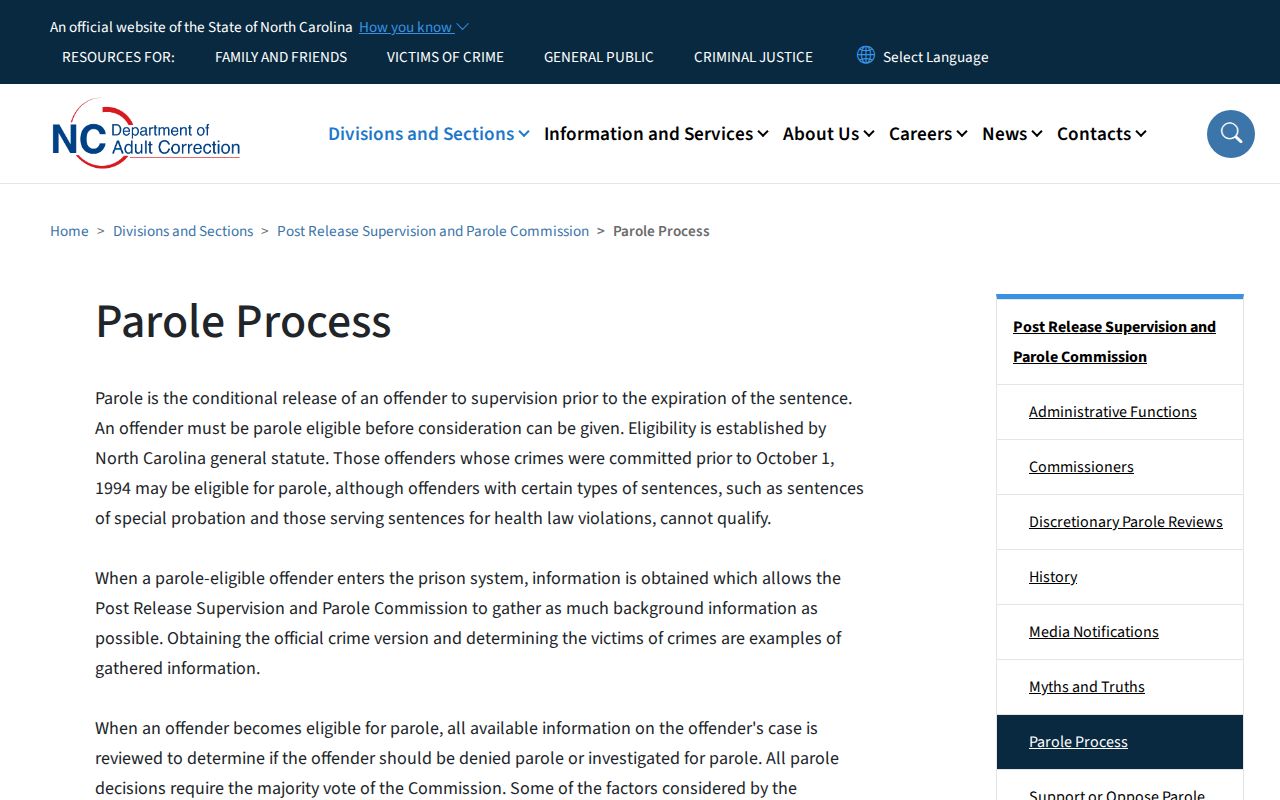
The state explanation helps identify when modern sentence rules apply and why parole should not be assumed for a current-law conviction.
Onslow County Release Credits and PRD
Several types of lawful credit can affect a projected state or county sentence date. G.S. 148-13 authorizes NCDAC credit rules and requires applicable regulations to be distributed to local jail administrators for sentenced jail prisoners. G.S. 15A-1355 permits earned credits consistent with NCDAC rules to reduce a maximum as allowed by the Structured Sentencing statute. Qualifying pretrial detention credit under Article 19A of Chapter 15 applies to minimum and maximum terms.
Good time and earned time are not always interchangeable labels. NCDAC explains that Fair Sentencing good time can award one day of credit for each day of good behavior, subject to forfeiture. Merit time may apply under Fair or Structured Sentencing. A disciplinary loss can move a date later, while restored or newly earned credit can move it within legal bounds. These rules depend on the sentence era and record.
The official calculation stays with the custodian. For a state sentence, Combined Records reviews the judgment, credits, sentence changes, and required checks before authorizing release. For a local jail term, Onslow County applies the lawful inputs to its maintained record. Neither calculation should be replaced with a guess based on the original sentence alone.
Why Onslow County Release Dates Change
NCDAC's victim-services material lists assignments, program participation or completion, discipline, transfers, and sentence credits as reasons a projected date may move. Courts can also modify or vacate a sentence. Additional cases and concurrent or consecutive terms can alter the calculation. The state policy requires authorization and checks external movements before release, so the displayed projection is not self-executing.
| Factor | Possible effect | Record to check |
|---|---|---|
| Earned or good time | May reduce the maximum within the governing rules | NCDAC or jail sentence calculation |
| Discipline | Loss or forfeiture of credit can move the projection later | Official custodian calculation |
| Program or assignment change | Can alter credit used in a state projection | Updated OPI and agency record |
| Court order | Modification or vacatur may change the sentence base | eCourts judgment and amended order |
| Added sentence | Concurrent or consecutive terms can recast the end date | Full sentence history |
| Detainer or transfer | May change the receiving custodian rather than sentence math | Release or transfer record |
The NCDAC projected-date explanation is the source for the state change factors.
The public explanation reinforces that a new assignment, discipline event, program result, or credit update can make a previously saved date stale.
Note: a detainer may affect where a person goes next even when the original custodian's projected sentence date does not change.
Onslow County Weekend Release Date Rules
NCDAC Release Policy Q.0100 says a projected state-prison release that falls on a weekend or holiday can be moved to the preceding weekday through discretionary credits. Minimum-date exceptions and eligibility constraints still apply. This is a specific state-prison rule. It should not be copied onto Onslow County jail releases.
No equivalent written weekend or holiday release policy was located for Onslow County Detention Center. A family member or support person should call Booking before travel and ask whether the named person's local sentence calculation and processing information can be confirmed. The absence of a published county policy does not establish a Friday-release rule, and NCDAC policy does not control the Sheriff's local release schedule.
Policy Q.0100 also shows why the word “projected” matters. Combined Records must authorize state release and external movements are checked. A weekend adjustment is not proof that no receiving authority exists, nor is it proof that a county detainee will enter the community on the same timetable.
Confirm an Onslow County Release
After the expected date passes, return to the responsible source. A state prisoner should have release history in OPI or the dedicated release search. A county detainee should have a Sheriff booking or release record. A VINE custody-change alert can add time-stamped evidence that the source agency transmitted a change, but it does not rule out another hold or receiving authority. Instructions for one-person alerts appear on the VINE Inmate Check.
Pair the custody record with the court timeline. The judgment explains the sentence or legal order. The custodian proves the operational release or transfer. If post-release supervision begins, OPI may show Active Probationer/Parolee even though prison custody ended. If the person moves to BOP, ICE, another county, or another state system, the new custodian's record is needed.
Was the projection wrong? Not always. It may have been accurate when viewed and then changed because the underlying credit, discipline, sentence, or transfer data changed. Save the date and time of each official check, then rely on the latest agency record.