
Onslow County Supervision Types
North Carolina uses three forms of community supervision that are often mistaken for one another. Probation is ordered by a court and can be used instead of incarceration or with a custodial part of a sentence. Parole is discretionary early release. It now applies mainly to older offenses and a limited set of statutes. Post-release supervision, often shortened to PRS, is the required community portion of many current-law felony sentences after a person leaves prison. The NCDAC Community Supervision overview is the official starting point for all three.
A person on any of these statuses may live in Onslow County while NCDAC supervises the case. Physical release is real, but it does not always end the sentence. PRS completion ends the covered sentence. A revocation can return the person to prison, and absconding does not count as successful discharge. A county booking record can prove that the Onslow County Detention Center released or transferred someone, but it does not by itself identify the later state supervision status.
| Status | How it begins | What release means | Official check |
|---|---|---|---|
| Probation | A court imposes it | The person is in the community under court-ordered terms | OPI status and NCDAC Community Supervision |
| Parole | The Parole Commission authorizes release in an eligible case | Prison custody ends, but parole supervision continues | OPI history, Commission material, and NCDAC confirmation |
| Post-release supervision | State law makes it part of a covered felony sentence | The person leaves prison before full sentence termination | OPI status and release or supervision history |
- Discharge
- The official end of custody or supervision shown by the responsible agency.
- Absconder
- A supervisee reported by NCDAC as failing to remain available for required supervision.
- Revocation
- An official action that can end community placement and return a person to custody.
Check Onslow County Post-Release Status
The public verification path starts with NCDAC Offender Public Information, known as OPI. Its coverage includes current and historical state prison offenders, probationers, and parolees back to 1972. It does not contain a county-jail-only booking that never entered NCDAC custody or supervision. The official help defines “Active Probationer/Parolee” as a person currently in the community under NCDAC supervision. “Inactive” means the person is no longer active as an inmate or supervisee, but the detailed dates and history must still be read before calling that status a discharge.
- Open the NCDAC OPI search and select All so active and inactive records can be found.
- Enter the last and first name. Add an offender number, date of birth, or age range when available to separate similar names.
- Open the likely result. Match the identity and offender number before relying on any supervision label.
- Read the incarceration, release, and supervision history. Do not treat an “Inactive” result as the release date.
- If the status is active or unclear, use the Community Supervision directory or published main contact to ask which office can confirm the public status.
The official OPI definitions show why the status choice matters.
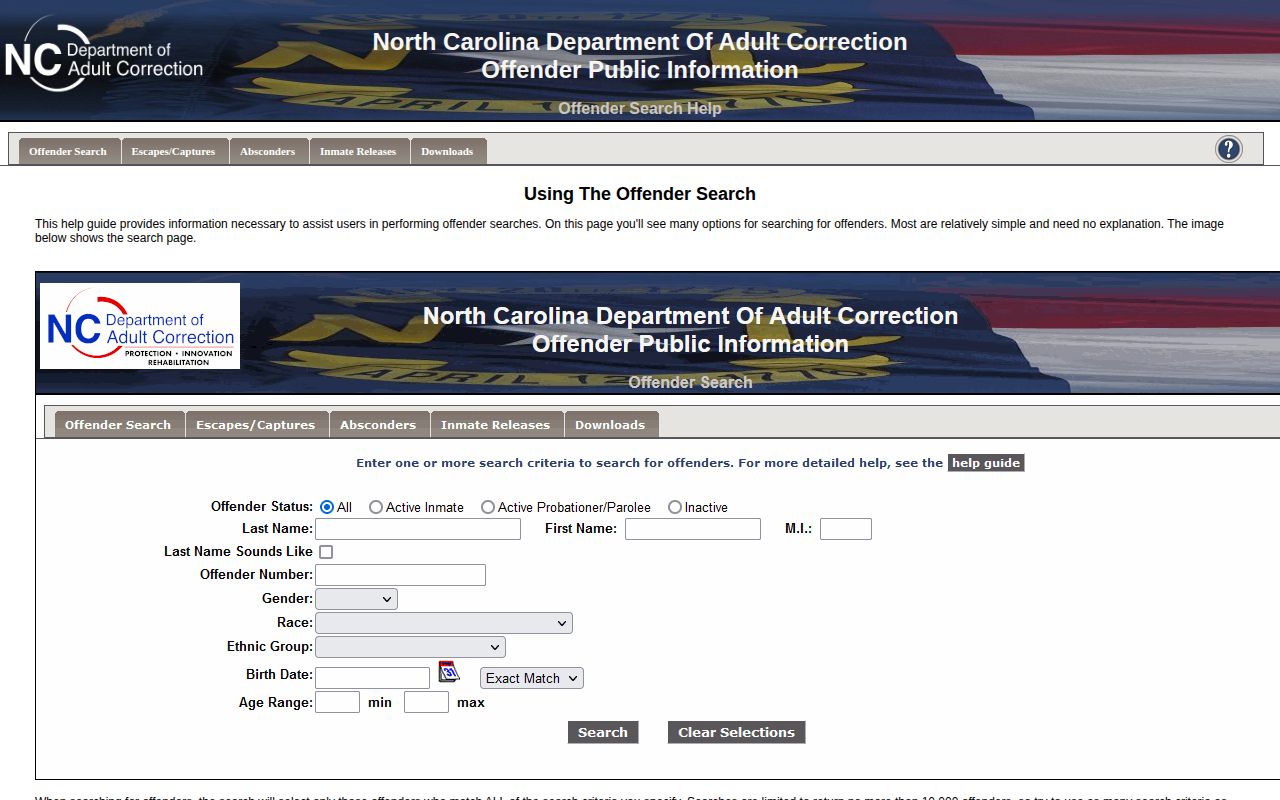
These definitions separate current prison custody, active community supervision, and inactive history, but the underlying record still supplies the useful dates.
Onslow County District 3 Supervision
Onslow County belongs to NCDAC Community Supervision Judicial District 3 with Carteret, Craven, Pamlico, and Pitt counties. The official office directory is the best route to a current local office because staff assignments and office listings can change. The Onslow County Detention Division separately publishes a local Probation number. Public records can confirm a status, but detailed conditions and an officer's complete working file may be confidential.
NCDAC Community Supervision
Judicial District: District 3, including Onslow County
Local Probation line: 910-347-5665
Main office: 2020 Yonkers Road, MSC 4250
Raleigh, NC 27699-4250
Main phone: 919-716-3100
The directory image below comes from the NCDAC local-office page.
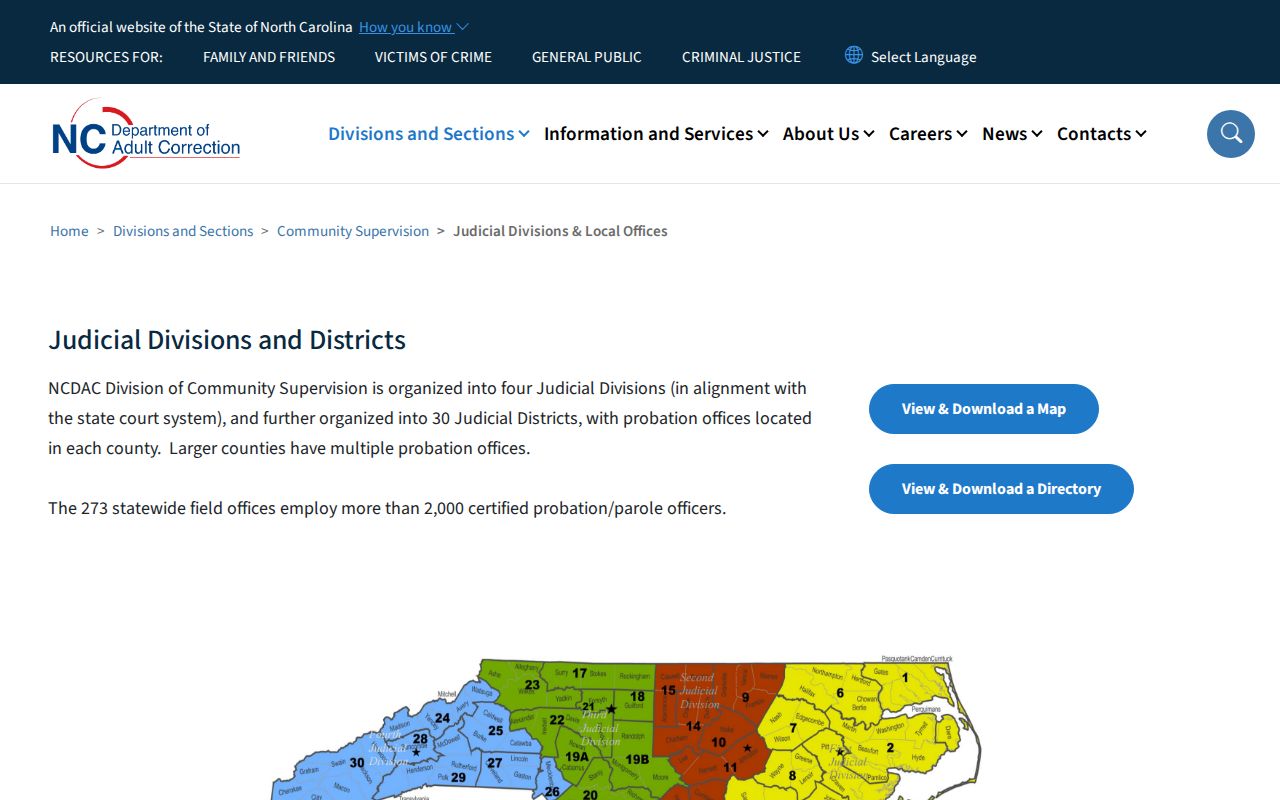
Use the live directory rather than assuming that an old office listing still routes the person or case.
Give only enough data to identify the correct public record. An offender number is more reliable than a name alone. If the issue is a county-jail release with no NCDAC record, contact Onslow County Booking or request the Sheriff release record instead. NCDAC expressly does not keep local jail records.
Note: a supervising office can confirm agency status, but it may not disclose private case plans, officer notes, or full supervision conditions.
Onslow County Post-Release Sentence Status
Article 84A of Chapter 15A governs post-release supervision. For many covered prisoners, the community portion begins before the maximum term ends. The statute generally sets the transition at the maximum less twelve months for Classes B1 through E, the maximum less nine months for Classes F through I, and the maximum less sixty months for specified maximum sentences, while also accounting for earned time. Those are statutory categories, not a way to calculate any one person's date without the judgment and official record.
Completion of PRS terminates the sentence. Before that point, the person has been released from physical prison custody but has not necessarily been fully discharged. This difference matters when reading an Onslow County result. A release date in NCDAC history answers when prison custody ended. An active probationer or parolee label answers whether community supervision remains. The broader release search and record path for a named person is covered on the Onslow County released inmates home page.
Parole works differently. Structured Sentencing largely ended discretionary parole for crimes committed on or after October 1, 1994. Modern cases generally move through the minimum and maximum sentence framework and then PRS. Parole remains relevant mainly to older-law offenses and specific statutes. It should not be assumed merely because a person is out of prison.
Onslow County Supervision Absconder Search
NCDAC maintains a separate Absconder Search that accepts surname and county of supervision. No separate Onslow County absconder list was found. A result in the state tool means the person has not successfully completed supervision. It signals an active whereabouts or compliance issue and must not be presented as a discharge certificate or a new release event.
Start with OPI because it gives the broader public history. Then use the absconder tool if the supervision status calls for that check. When a person is believed to be supervised in another state, NCDAC's Interstate Compact information is the right routing source. A move across state lines can continue supervision and does not by itself mean the Onslow County case ended.
The official absconder form shows the available search fields.
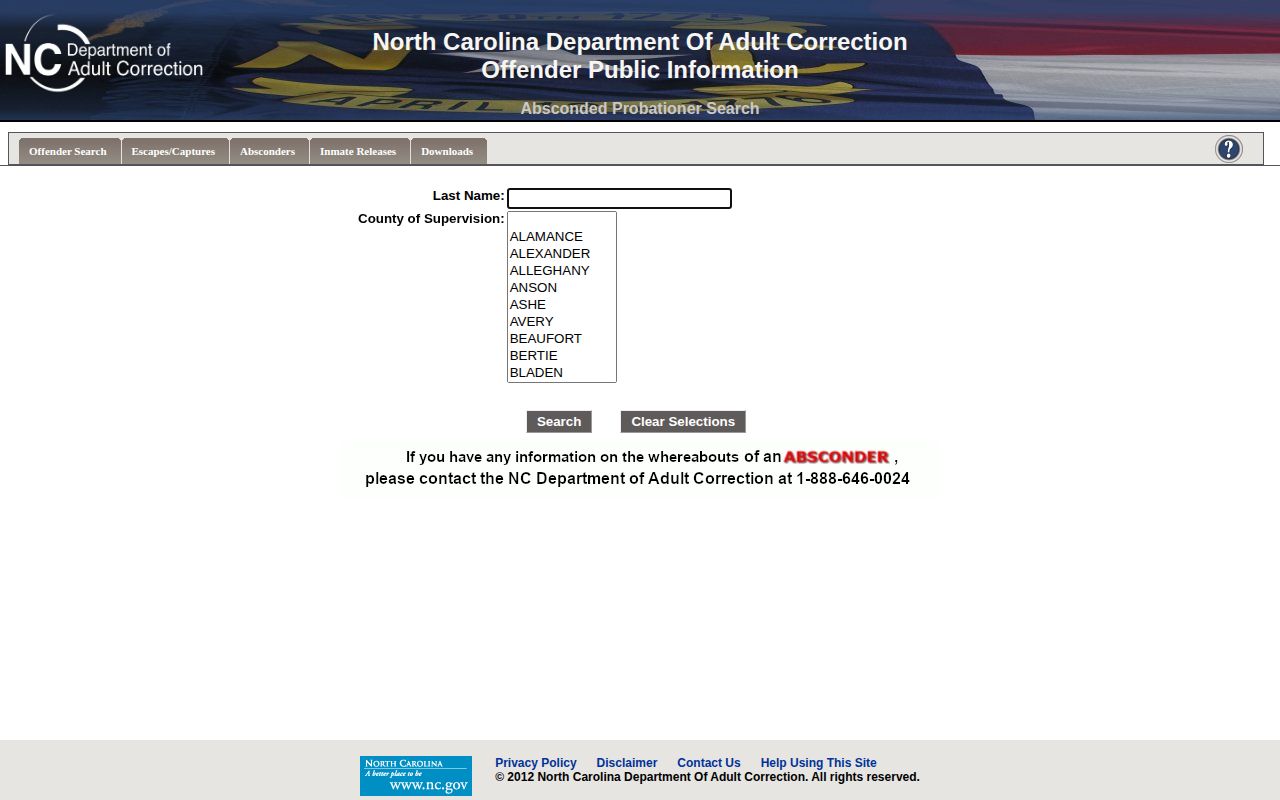
The county-of-supervision field helps narrow the result, but identity still must be matched in the detailed offender record.
Onslow County Parole Reviews
The North Carolina Post-Release Supervision and Parole Commission is a four-member body whose decisions require a majority. North Carolina does not publish a normal future calendar of face-to-face parole hearings. Ordinary reviews are file reviews. Commissioners review and vote independently, with no formal group hearing and no personal meeting with the offender. A claimed “next hearing date” should not be inferred when the state publishes no such ordinary calendar.
The closest official results source is the Monthly Discretionary Parole Reviews page. Reports available there since September 2024 list reviewed cases and the source's own outcomes. Eligible cases generally receive review at least annually after eligibility. First- and second-degree murder cases are normally reviewed every three years, while sexually violent offenses are reviewed every two years. A special juvenile-life videoconference process should not be generalized to ordinary cases.
A denial means custody continues under that review. Movement into investigation is not physical release, and “Suspend Decision” stops further consideration at that point. A favorable step must be paired with the OPI or Inmate Release Search record to confirm an actual release. G.S. 15A-1371 and Article 85 govern the remaining parole-eligible categories. There is no ordinary administrative appeal from the Commission decision.
Note: use the exact disposition in the monthly report because North Carolina outcome terms do not always match generic parole labels.
Onslow County Post-Release Reentry Help
The Jacksonville Onslow Welcome Home Council serves people returning to Onslow County from a local jail and from state or federal prison. Support can begin before release or after return. Its purpose-neutral services include case management, plans for immediate needs, transportation support, links to community resources, and substance-treatment connections. This is local navigation after release, not an official supervision record.
Jacksonville Onslow Welcome Home Council
Reentry Coordinator: Elizabeth LaPenta
Phone: 910-347-2646
Email: blapenta@uwonslow.org
Location: 118 Chaney Avenue, Jacksonville, NC
A supervisee should still use NCDAC for official reporting instructions. The Council can help with local connections, but it cannot change a release date, parole decision, probation term, warrant, or reporting requirement. Calling early can help distinguish practical return needs from agency obligations.
Confirm Onslow County Supervision Discharge
Discharge is the end point, not merely a move from one status screen to another. Review the OPI supervision dates and history, then ask NCDAC which public record confirms completion if the screen is unclear. An Inactive result can include a person formerly in prison, probation, or parole, so it needs context. The detailed record must show which episode ended and when.
Keep the authorities separate. Onslow County Booking confirms a jail release or transfer. NCDAC confirms state custody, probation, parole, and PRS. The Parole Commission decides eligible parole matters. A court record explains the judgment and legal events, but not the exact time a jail opened its door or whether another custodian accepted the person. Matching these records avoids calling transfer, revocation, or inactive history a clean discharge.
NC SAVAN can send notice when a linked jail or Adult Correction source transmits a qualifying custody change. It covers prison, probation, and parole subject to published exclusions, but the alert is not the full supervision file. Save the alert and verify the current OPI status because a person can have separate county and state identifiers.